
Dr. Tokie Laotan-Brown, FOPCHEN
ISCCL Expert member, Nigeria
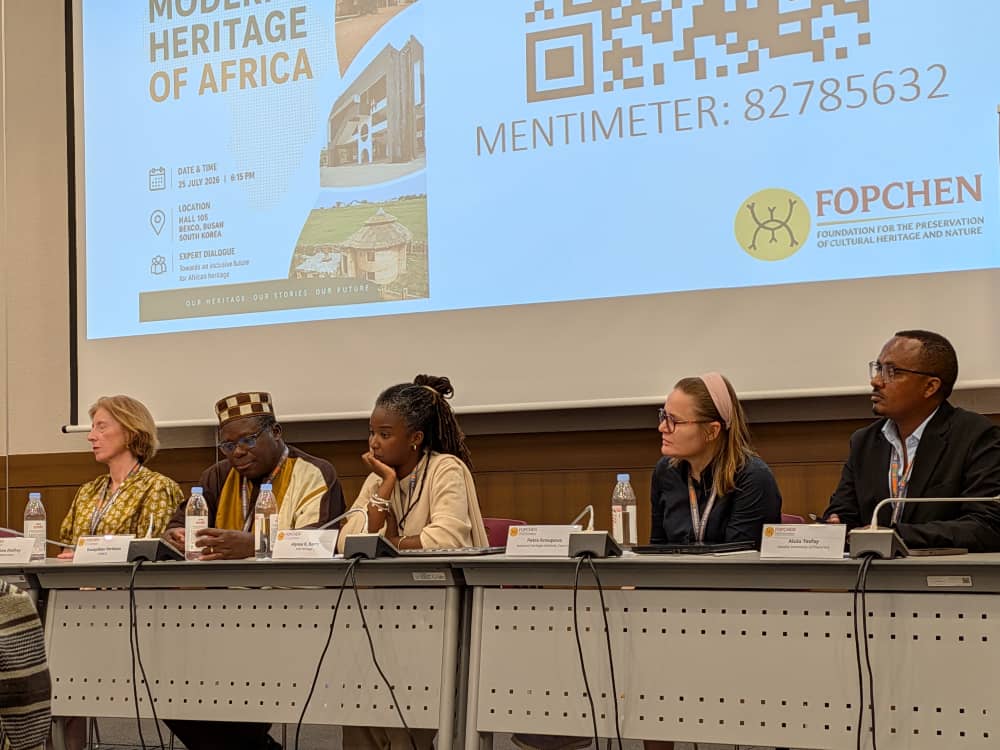
The 48th session of the UNESCO World Heritage Committee was historic in more ways than one. For the first time since joining the Convention in 1988, the Republic of Korea hosted this gathering of nations. A session that UNESCO’s World Heritage Centre Director described as “historic” for the sheer scale of participation. Over ten days in the vibrant port city of Busan, delegates from 196 States Parties, 21 Committee member states, and three advisory bodies came together to confront the most pressing challenges facing our shared heritage. At the heart of this gathering was the adoption of the Busan Declaration on World Heritage. A landmark agreement that elevates “collaboration” as a sixth strategic objective, joining the existing “5 Cs” of credibility, conservation, capacity-building, communication, and communities. As the Korea Heritage Service administrator Huh Min declared, this is “the core achievement of this World Heritage Committee session and a milestone for the future” of the 1972 Convention. The declaration broke new ground by formally confronting the rise of artificial intelligence and demanding transparent, responsible digital practices in heritage preservation. It was within this momentous context that Dr Tokie Laotan-Brown and her colleague Tobiloba Akibo with a team of six from Africa. We represented the Foundation for the Preservation of Cultural Heritage and Nature (FOPCHEN).
Dr Tokie Laotan-Brown spoke at the Mesh IN side-event with a framing remark that set the tone for everything that followed. The answer lies in practice. In her talk, she showcased two projects that exemplify what happens when heritage work becomes relational, interconnected, and deeply rooted in community.
The Ala Ile App is a digital platform designed to document, preserve, and transmit Africa’s intangible cultural heritage: oral histories, crafts, indigenous practices. Thus, making ancestral knowledge accessible to younger generations through technology. It empowers communities to become active custodians of their own heritage. It bridges the gap between tradition and modernity. And it aligns with UNESCO’s 2015 Recommendation on museums and documentation.
The Net Zero Building in Kurudu, Abuja is something else entirely. Supported by the Gerda Henkel Stiftung, it trains unemployed youth in sustainable construction while reviving indigenous West African building techniques. Rammed-earth construction, naturally suited to the continent’s climate. The building was brought to life through design inspired by the Nsibidi symbols of Unity, Peace, Love and Welcome. An ancient script from Southern Nigeria. Locally sourced laterite earth, stabilised with minimal cement and stone dust, becomes the foundation of a structure that is at once heritage-inspired and future-facing. Young people transition from unskilled labourers to skilled artisans and master builders.
As Dr Tokie explained: “Neither of these projects was mandated by a policy framework. They emerged because heritage realities are entangled, and because practice requires us to combine methods, knowledge, and responsibilities across domains.”
But practice alone is not enough. It must be amplified by policy. This is where the Modern Heritage of Africa (MoHoA) programme enters the picture. A FOPCHEN side event at the 48 COM WHC. A collaborative effort coordinated by FOPCHEN in partnership with UNESCO (African Unit) and ICOMOS. MoHoA aims to define, identify, protect, and promote modern heritage across the African continent. It challenges the Eurocentric notion of “modernism” by centring African epistemologies and plural modernities. It builds on the Cape Town Document of 2021 and recognises that Africa’s modern heritage encompasses the colonial and post-colonial, the tangible and intangible, the urban and rural, culture and nature.
Dr Tokie made the stakes clear: “This is not about simply adding more sites. It is about de-centring heritage discourse and creating a new conceptual understanding that reflects Africa’s plural modernities. Cities like Rabat and Asmara are already inscribed. MoHoA goes further. It develops clear guidance for States Parties, helps update tentative lists, and paves the way for an equitable and sustainable heritage future.”