
Wataru ONO, Consultant to the Agency for Cultural Affairs, Japan
ISCCL Expert member, Japan
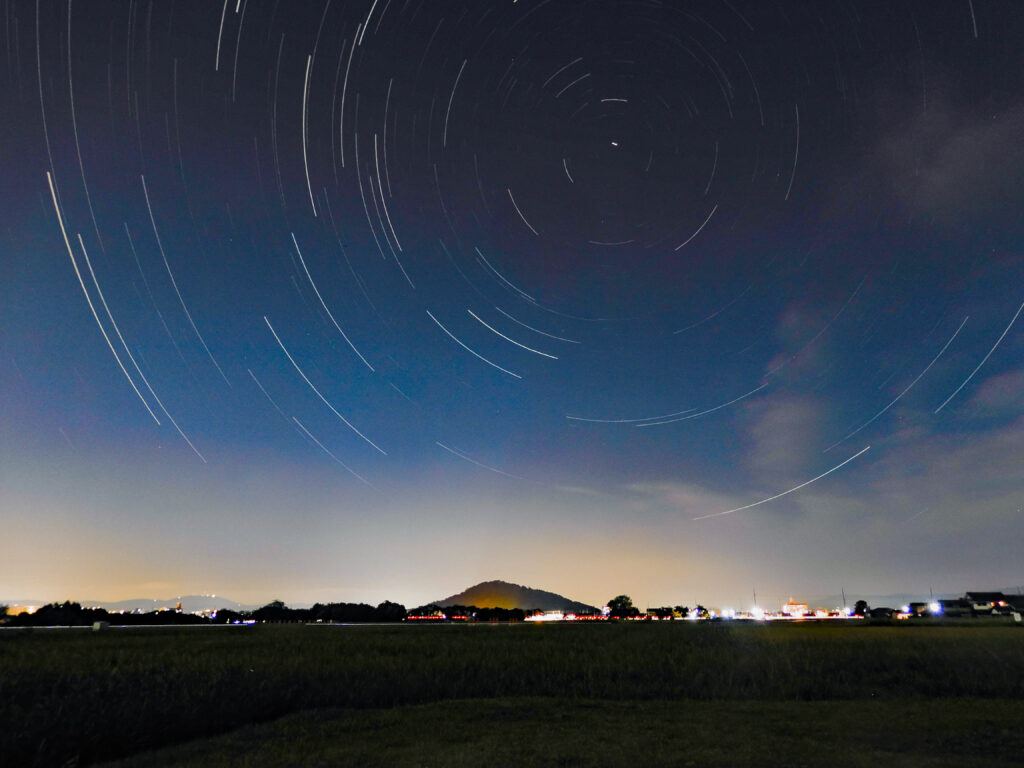
Polaris above the Fujiwara Palace Site, Kashihara City, Japan. Image by Wataru Ono
I participated in the 48th session of the World Heritage Committee (Busan, Republic of Korea) as a consultant accompanying the Agency for Cultural Affairs, Government of Japan to record and follow the discussions to prepare a report for information to Japanese stakeholders. Therefore, I stayed in the meeting venue from the morning till the evening every day from the first day to the last day of this meeting, in which more than 2,000 people from approximately 140 countries participated, including many colleagues from the ISCCL.
This was a special meeting for me personally, as I was able to witness the successful inscription of the Ancient Capitals of Asuka and Fujiwara, nominated from Japan, for which I had a opportunity to work as a consultant over a decade in the process of preparing the nomination dossier. Allow me to take this opportunity to thank ISCCL colleagues who also cooperated in various international expert meetings and those who may have participated in the evaluation without being known publicly.
The newly inscribed serial World Heritage property, Ancient Capitals of Asuka and Fujiwara, consists of 19 archaeological sites of ancient palaces, Buddhist temples, and mounded tombs mainly from the 7th century. It is not a cultural landscape per se, but contains elements of cultural landscapes, such as one of the oldest archaeological sites of palace gardens in Japan, the geographical setting and location of the seat of the palace in relation to the surrounding natural and intangible features (mountains, a river, Polus, constellations, cardinal orientations), and use of symbolic geometric forms (e.g., square, circle, hexagon) of the palaces and tombs to represent, for example, the earth (square) and the celestial world (circle).
However, no cultural landscapes were inscribed on the World Heritage List at this meeting for the first time since 1995. I hope to see the inscription of cultural landscapes come back and increase again with more diversity and new perspectives in future meetings.
Towards the end of the World Heritage Committee meeting, another big earthquake hit Kumamoto Prefecture in south Japan across the strait from Busan, Republic of Korea, causing casualties and damage to buildings, infrastructure, and cultural properties. This area was hit by a big earthquake 10 years ago and is in the midst of recovering from the previous damage. Local government officers of Kumamoto Prefecture, including an ICOMOS member, were also attending the World Heritage Committee and various side events to learn about World Heritage in preparation of future nomination of the Aso Caldera cultural landscape, about which the poster session has been accepted at the coming General Assembly meeting in Kuchin, Malaysia. Although it is now uncertain whether they can participate in person, I will participate in the GA myself and attend to the poster session introducing this cultural landscape as one of the co-authors.